

STUDENT USES EMERGING TECH, MEDICINE TO EMPOWER THOSE WITH BRAIN INJURIES
By Jen Cramer
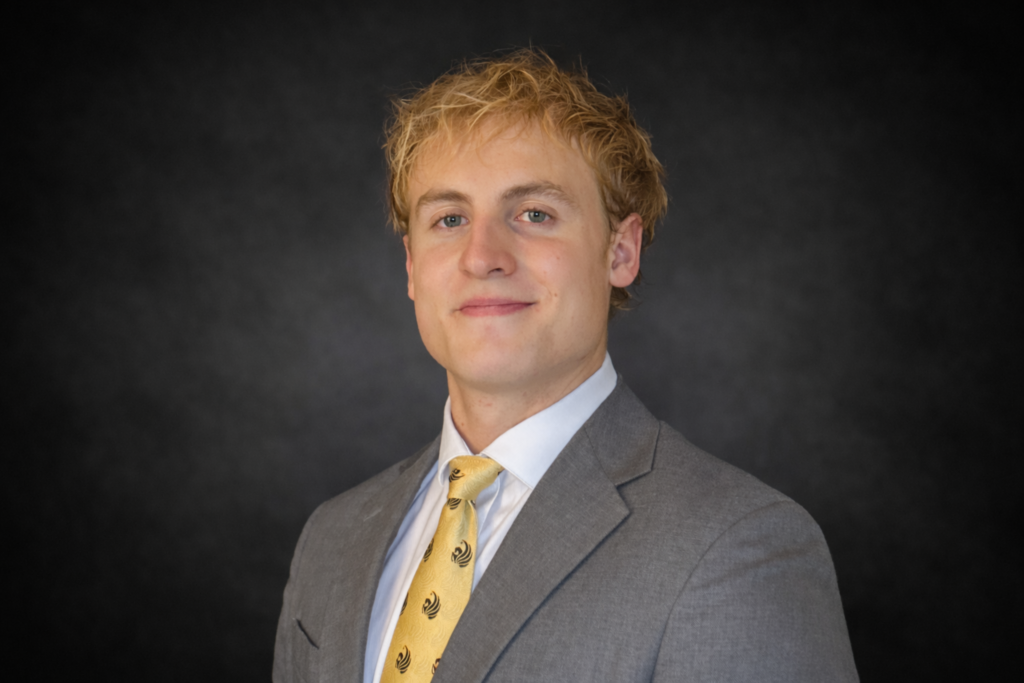
Kyle Coutray has always been fascinated by anything having to do with robots or electronics.
But in high school, that curiosity became personal. On the way home from a neighborhood basketball game, his friend was injured in a skateboarding accident and suffered one of the most severe types of traumatic brain injury. It happened right in front of Coutray, and to this day, his friend has never fully recovered.
During his freshman year at UCF, Coutray took his first neuroscience class to try to make sense of this senseless accident. He became absorbed in understanding the brain and fascinated by the potential to restore what can be lost.
A Burnett Honors Scholar, he’s in a unique dual-degree program at UCF’s College of Engineering and Computer Science and College of Medicine studying computer engineering and biomedical sciences, with a focus on neuroscience. Now in his fourth year, he’s integrating technology and medicine, focusing on a concept called intent decoding, which uses technology to translate what someone wants when they don’t have the ability to express it due to limited mobility or a cognitive issue.

His ultimate goal is to develop assistive technologies that restore function and empower people of all abilities, including those with traumatic brain injuries, neurological disorders or cognitive impairments.
“I don’t believe that injury or disability should define how a person interacts with the world,” Coutray says. “I don’t just want to study the brain — I want to give people their lives back.”
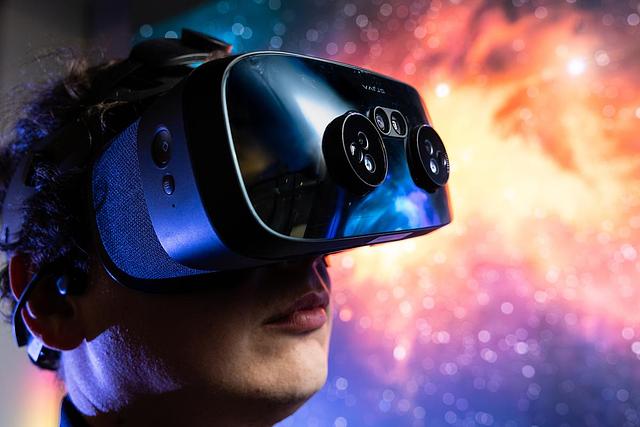
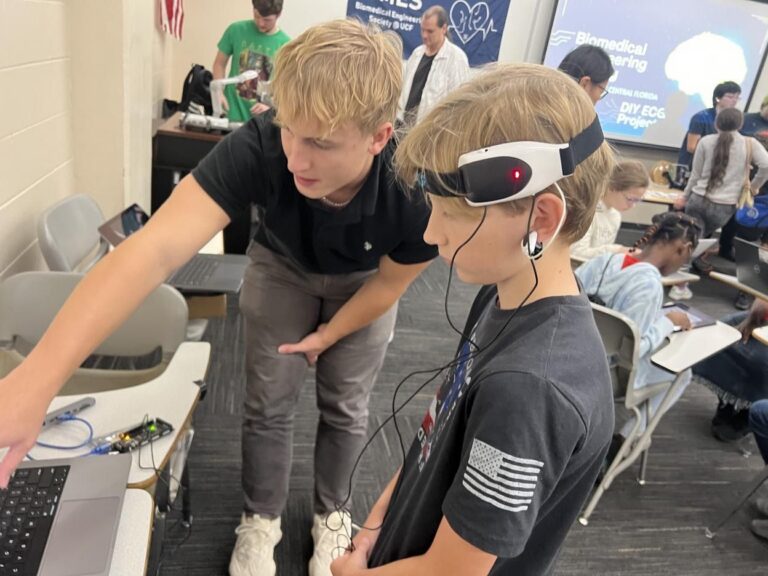
As a freshman, Coutray was a research assistant in a human-computer interaction lab at UCF. He co-led a project using EEGs on the scalp to measure brain waves, along with virtual reality headsets and eye-tracking cameras.
The goal was to enable hands-free interaction for people with limited mobility. In a clinical setting, for example, that could mean helping someone move a prosthetic limb more naturally using a brain-computer interface.
“Growing up, I was actually a huge ‘Star Wars’ Fan, and to me, this was like using the force to control things with your mind,” Coutray says. “The brain remains one of the greatest frontiers of human understanding, and it holds enormous promise for life-changing discoveries.”
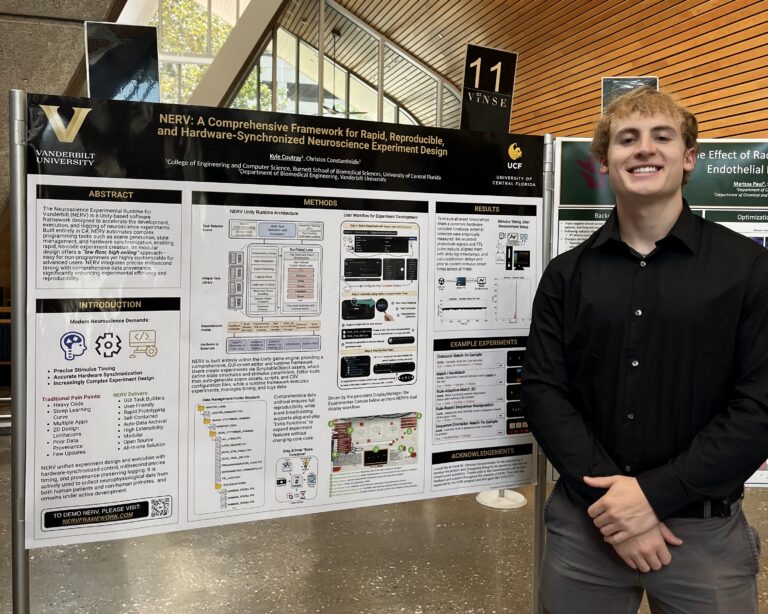
Last summer, he had the opportunity to work in a lab at Vanderbilt University, doing research related to Alzheimer’s and Parkinson’s disease. This year, he’s working in UCF’s Biomechanics, Rehabilitation, and Interdisciplinary Neuroscience – or BRaIN Lab — researching VR based neurorehabilitative systems that help people move and walk better.
After graduation, he plans to pursue a Ph.D. in Neural Engineering, with the goal of eventually working for a company that’s dedicated to unlocking human potential through brain-computer interfaces.
“UCF has given me incredible opportunities that have prepared me for what’s ahead,” Coutray says. “I’m so proud to be a Knight.”
He recalls that what brought him to UCF in the first place was the university’s student-centered approach and welcoming atmosphere.
After moving from Arkansas to Florida the summer before his senior year of high school, he toured all the major Florida universities. But nothing compared to his experience at UCF.
“Here on campus, I immediately felt this strong sense of culture and school spirit. We had an amazing tour guide, and as we stood in front of the Reflecting Pond, he told us all about Spirit Splash and the ducks at homecoming. Everyone seemed excited to be here.”
He recounts that other universities talked about why he should want to be part of their institution. But at UCF, the focus was on the students.
“Here, everyone talked about what they could do for students — for me. How they could help me pursue my interests and reach my goals,” says Coutray. “It was the only school that seemed to have that mindset of being here for the students, instead of the students being there for the institution.”
Then, the Burnett Honors College reached out proactively to invite him to create his own path through the dual-degree program that he’s in now. That sealed the deal.
Last year, Coutray was named an Astronaut Scholar, one of the most prestigious programs for the country’s brightest minds in STEM. This year, he is receiving the Goldwater Scholarship, which honors our nation’s next generation of research leaders in science, engineering and math. At UCF, he was selected for Order of Pegasus — UCF’s top student award recognizing the most dedicated, passionate and highest achieving Knights — and he also serves on the President’s Leadership Council.
One of four children in his family, Coutray has benefited from several scholarships that have supported his studies, research, and internships, including scholarships that are donor funded.
“My experience at UCF has changed my life and solidified my mission to use what I’m learning to help change the lives of others,” he says.
And as an undergraduate student, he is just getting started on his journey to boldly invent the future. That journey will include his dream internship this summer at Paradromics in Austin, Texas, a company that specializes in developing brain-computer interfaces for applications in healthcare.
Coutray shared his story as a featured speaker at UCF’s Go For Launch campaign liftoff, inspiring the UCF community with the impact that a Knight education can have not only on students, but on all lives those students will touch in the future.
Stories like his demonstrate why Go For Launch is so important: Investments in UCF fuel breakthroughs, support students and create world-changing impact.